PROJECT 03
AI-Driven Autonomous Surveillance Drone
Custom quadcopter running YOLOv7 on-board, autonomous navigation on PX4, and low-latency MAVLink telemetry.
91.2%
mAP@0.5 (YOLOv7)
23 FPS
On-Pi inference
93%
Mission success
550 m
Telemetry range
Overview
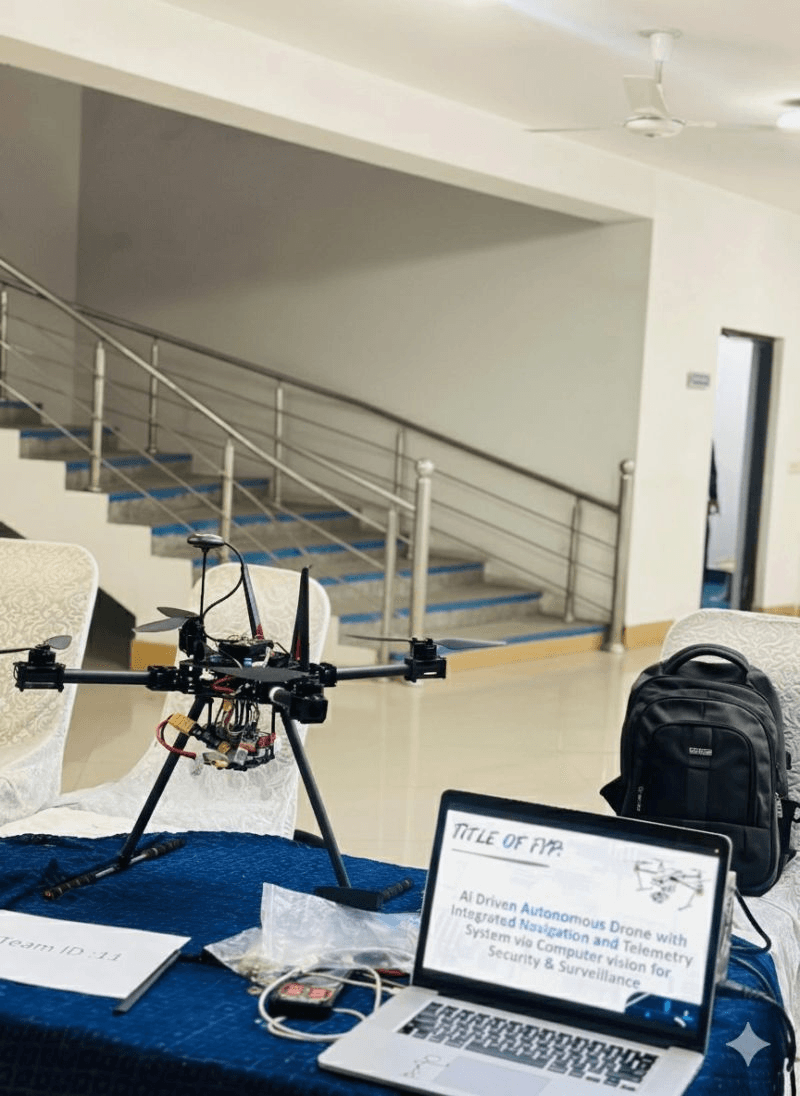
A custom quadcopter platform engineered for security and surveillance workloads that would traditionally require an operator in the loop and a ground processing pipeline. The airframe carries an on-board AI companion computer running YOLOv7 for real-time object detection, license-plate reading and face recognition directly against the camera feed.
A PX4-based flight controller handles autonomous mission execution and obstacle avoidance, while a MAVLink telemetry link streams position, video and system state back to a Mission-Planner-based ground control station.
The design goal was operational autonomy: the drone plans and flies its own missions, makes perception decisions on-board without a cloud round-trip, and continues to operate meaningfully in GPS-degraded conditions using visual/inertial cues. The platform was built end-to-end — mechanical frame, avionics integration, perception stack and ground software — and validated in both simulation and outdoor field trials.
System Architecture
Camera Front End
Runcam Thumb
On-Board AI Engine
Raspberry Pi 5 · YOLOv7 · TensorRT-optimised inference
Flight Controller
Cube Orange · PX4 firmware · EKF sensor fusion
Sensor Suite
Neo-M8N GPS · IMU · barometer · ultrasonic obstacle sensing
Telemetry Link
MAVLink over 433 MHz radio + Wi-Fi video, < 200 ms latency
Ground Control Station
Mission Planner + custom Python/OpenCV dashboard
Hardware
| Subsystem | Selection & Role |
|---|---|
| Airframe | Custom 550 mm carbon-fibre quadcopter; CAD-designed and CNC-machined for precise motor/sensor placement and structural stiffness |
| Propulsion | Brushless DC (BLDC) motors, KV720, with foldable composite propellers; sized for the target thrust-to-weight and endurance envelope |
| Flight controller | Cube Orange running PX4 firmware — open-source autopilot with EKF-based state estimation |
| AI companion | Raspberry Pi 5 (8 GB) running YOLOv7 inference locally; connected to the flight controller over MAVLink |
| Camera | Runcam Thumb module streaming real-time video to the AI companion for object detection, tracking and recognition |
| Sensors | Neo-M8N GPS, IMU and barometer for state estimation; ultrasonic sensors for close-range obstacle detection (~4 m) |
| Power | 4S 5200 mAh Li-Po pack feeding both propulsion and computation; sized for full-mission continuous inference |
Software & AI
The perception stack runs a custom-trained YOLOv7 model on the on-board Raspberry Pi, targeting surveillance-relevant classes (people, vehicles, bags, intruders) via transfer learning from COCO weights. Training-time augmentation covered rotation, brightness normalisation and motion blur to reflect real airborne footage. The deployed model is optimised with TensorRT to hit the frame-rate budget required for live detection during flight.
A SORT (Simple Online and Realtime Tracking) layer maintains identity across frames for smoother tracking of moving subjects.
Autonomous flight combines A*-based waypoint planning against the mission map, fuzzy-logic obstacle avoidance fed by IR and ultrasonic sensor data, and an EKF that fuses IMU, barometer and GPS into a robust pose estimate. The GCS was implemented as Mission Planner alongside a custom Python + OpenCV dashboard that overlays live YOLOv7 detections onto the video feed.
Key Engineering Work
- End-to-end airframe engineering — SolidWorks-based design, CNC-machined carbon-fibre parts, and full mechanical / avionics integration into a flight-ready platform
- Custom YOLOv7 training pipeline (transfer learning from COCO, targeted augmentation) for surveillance classes, and TensorRT-optimised deployment on the Raspberry Pi 5
- SORT-based multi-object tracker layered on top of the detector to hold identity across frames during airborne motion
- Autonomous mission stack on PX4 with A* planning, fuzzy-logic obstacle avoidance and EKF-based state estimation fusing IMU, GPS and barometer
- Custom GCS dashboard combining Mission Planner with a Python/OpenCV overlay that unifies live detections, telemetry and mission state in one operator view
- Simulation-first validation strategy: MATLAB dynamic modelling, Simulink + PX4 software-in-the-loop, and hardware-in-the-loop testing before every outdoor flight
Results & Validation
Perception Performance
Flight & Telemetry
Simulation results (MATLAB + Simulink + PX4 SITL + HIL) tracked field results within expected margins, giving high confidence that the on-board control loop matched the modelled dynamics prior to outdoor flight.
Technical Stack
Hardware
- Custom 550 mm carbon-fibre airframe
- Cube Orange flight controller
- Raspberry Pi 5 AI companion
- Runcam Thumb camera
- Neo-M8N GPS · IMU · barometer
- Ultrasonic obstacle sensors
- BLDC motors + foldable props
- 4S 5200 mAh Li-Po pack
Firmware & AI
- PX4 (C/C++) autopilot firmware
- YOLOv7 object detection
- SORT multi-object tracker
- TensorRT inference optimisation
- OpenCV pre/post-processing
- A* path planning
- Fuzzy-logic obstacle avoidance
- EKF sensor fusion
Ground & Sim
- Mission Planner GCS
- Custom Python + OpenCV dashboard
- MAVLink telemetry protocol
- 433 MHz radio + Wi-Fi video
- MATLAB dynamic modelling
- Simulink + PX4 SITL
- Hardware-in-the-loop rig
- SolidWorks + CNC toolchain